Tools & Glue: The Botany of the Hardware Store
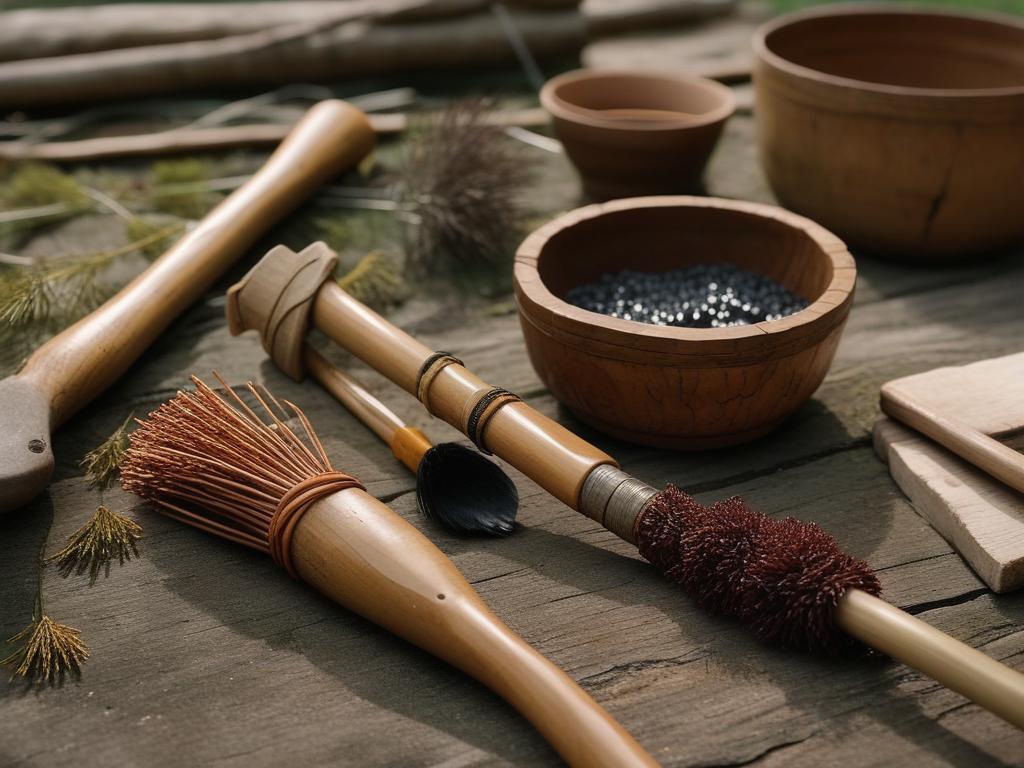
The Botanical Toolbox
Stone and bone provided the edge, but it was botany that provided the handle, the binder, and the finish. On the Great Plains, every tool—from the humble hide-scraper to the high-performance war bow—was a composite structure, engineered by combining materials with complementary physical properties. The ability to create permanent, waterproof adhesives and shock-resistant shafts allowed Plains Native nations to build a complex technological world from a seemingly simple environment.
In this final 2,000-word installment of our Materials Series, we step inside the “botanical hardware store” to explore the chemistry of traditional adhesives, the material science of tool-handle selection, and the advanced finishes used to preserve these essential assets against the relentless prairie elements.
1. Adhesives: The Science of Stickiness
In a world before screws and nails, adhesion was the primary method of joining disparate materials. Plains Native engineers utilized two distinct types of glue: animal-based “protein glues” and plant-based “resinous cements.” Often, they combined the two for maximum durability.
I. Pine Resin (The Thermosetting Cement)
The sap of the pine and juniper trees is a complex mixture of liquid terpenes and solid rosins. When heated, the resin becomes a viscous liquid; when cooled, it hardens into a brittle, glass-like solid.
- The Filler Strategy: Pure pine resin is too brittle for tool-making; a tool handle joined with pure resin would shatter upon the first impact. To solve this, Plains engineers used fillers. By mixing crushed charcoal or finely ground bison dung into the molten resin, they created a “composite cement.” The charcoal particles act as “crack-stoppers,” preventing a fracture from propagating through the material.
- Pitch Sticks: This mixture was often formed into “pitch sticks”—pre-mixed cakes of resin and charcoal that could be stored indefinitely and melted over a small flame whenever a repair or a new lashing was needed.
II. The Synergistic Bond: Glue and Sinew
While resin provided the “seat” for a tool head, the primary structural bond was often a combination of hide glue and sinew lashing.
- Hide Glue: Produced by boiling the collagen-rich trimmings of buffalo hide (the “scuddings”) until the liquid reduced to a thick, amber syrup.
- The Reaction: When wet sinew (animal tendon) is soaked in warm hide glue and wrapped around a tool handle, it undergoes a transformation as it dries. The sinew shrinks, exerting hundreds of pounds of compressive force, while the glue bonds the fibers into a single, monolithic block. This “composite lashing” is virtually indestructible and was the secret behind the durability of Plains war clubs and hoes.
2. Tool Handles: The Physics of the Shaft
Choosing the right wood for a tool handle required an understanding of Young’s Modulus (stiffness) and fracture toughness.
I. Chokecherry (Prunus virginiana): The Shock Absorber
Chokecherry was the preferred wood for handles of impact tools like mauls and hammers.
- Materials Property: Chokecherry has a high “interlocking grain” structure. This means the cellulose fibers are woven together in a way that prevents the wood from splitting under sudden, heavy loads.
- Application: A stone maul head lashed to a chokecherry handle provided a tool that could shatter a buffalo’s leg bone without the handle snapping in the user’s hand.
II. Green Ash (Fraxinus pennsylvanica): The High-Tensile Arcs
Ash is famous for its combination of strength and elasticity.
- Materials Property: Ash has long, straight starch-filled vessels that allow it to be bent significantly without reaching its elastic limit.
- Application: Ash was the primary material for bows (among tribes without access to Osage Orange) and for the frames of snowshoes. Its ability to “spring” back to its original shape made it the ideal material for any tool requiring seasonal flexibility.
III. Dogwood (Cornus spp.): The Hard-Use Straight Grain
Dogwood is incredibly dense and has a very fine, closed grain.
- Materials Property: High abrasion resistance and dimensional stability.
- Application: Dogwood was the primary choice for arrow shafts and drilling spindles. Its density allowed it to withstand the friction of fire-starting without wearing down prematurely.
3. The Bow: The Ultimate Botanical Engineering
The Great Plains bow was the peak of pre-industrial material science. It was almost always a composite or sinew-backed structure.
The King of Wood: Osage Orange (Maclura pomifera)
In the southern Plains, the “Bois d’Arc” (Wood of the Bow) was the most prized botanical material in the world. Osage Orange is so dense it sinks in water and contains natural fungicides that make it virtually rot-proof.
- Physics: Its exceptional compressive strength allowed for a shorter, more powerful bow that could be easily maneuvered from the back of a galloping horse.
Sinew-Backing and Botanical Glue
To increase the power of the bow, layers of shredded sinew were glued to the “back” (the side facing away from the archer) using high-purity hide glue.
- The Composite Action: When the bow is drawn, the wood is under compression, while the sinew is under tension. Because sinew is significantly stronger in tension than wood, this combination allowed for a draw-weight that could exceed 60 pounds, producing an arrow velocity capable of passing entirely through a full-grown bison.
4. Finishing and Preservation: The Science of the Surface
A tool is only as good as its maintenance. The Great Plains environment—with its radical humidity shifts—would quickly warp or crack unprotected wood.
I. Abrasives: Scouring Rush (Equisetum)
Before sandpaper, there was the Scouring Rush. This plant concentrates silica (glass) from the soil in its stems.
- The Natural Sandpaper: The ribbed, silica-rich stalks of the Equisetum were used to “sand” arrow shafts and tool handles to a glass-like smoothness. This was not just for aesthetics; a smooth arrow shaft has less wind resistance and is less likely to splinter into the archer’s hand upon release.
II. Sealants: The Protective Oils
Once smoothed, the wood had to be sealed.
- Sunflower Oil: As a drying oil, sunflower oil eventually oxidizes into a hard, protective film. Rubbing sunflower oil into an ash bow protected it from the excessive drying of the summer sun.
- Pine Resin Varnish: A thin wash of melted pine resin and fat was often used to waterproof the sinew-backing of bows, ensuring the glue didn’t re-hydrate and fail in the rain.
5. Mechanical Advantage: The Power of the “Crank”
The Plains nations utilized the principles of the lever and the wedge in their botanical tools.
- The Digging Stick (Ičápi): Usually made of a fire-hardened hardwood like Oak or Ash. Its length was engineered to provide maximum leverage when prying deeply rooted tubers like Breadroot from the sun-baked prairie soil.
- The Wedge: Simple wedges of Oak or Chokecherry were used to split massive Cottonwood logs for shelter. By driving the wedge along the grain, a single person could exert thousands of pounds of pressure, accurately “planing” a log into a flat board.
6. The Ethics of the Toolbox: Longevity and Respect
In traditional Plains culture, there was no “disposable” tool. A tool was a relationship. The time required to find the perfect chokecherry branch, the weeks needed to season the wood, and the days spent grinding the resin meant that a tool was a significant life investment.
This led to an ethic of extreme repairability. When a handle broke, it was spliced and re-glued. When a blade wore down, it was re-hafted. This cycle of maintenance fostered a deep intimacy with the materials. The user didn’t just “own” the tool; they were the curator of its continued existence.
7. Modern Revitalization: Craft as Connection
Today, the “maker movement” is beginning to rediscover these traditional materials. For the modern woodworker or outdoorsman, learning to make your own pine-pitch glue or to sand with Equisetum is an exercise in de-coupling from the industrial supply chain. It proves that everything we need to build, fix, and create is already growing in the creek bed or the forest edge.
View Traditional Woodworking and Tool-Making Supplies on Amazon
Technical Summary: The Strength of Plains Hardware
| Purpose | Botanical Material | Key Property |
|---|---|---|
| Heavy Lashing | Rawhide + Hide Glue | Tensile Strength + Adhesion |
| Tool Handles | Chokecherry / Ash | Impact Resistance / Flexibility |
| Precision Shafts | Dogwood | Dimensional Stability |
| Hard Adhesive | Pine Resin + Charcoal | Thermal stability (Thermoset) |
| Abrasion | Scouring Rush (Equisetum) | Silica Content (Natural Sandpaper) |
This concludes our Materials Series. Next Batch: Ethics of the Prairie - Foraging, Respect, and Tradition.