Roots of Resilience: The Starch Economy
The Hidden Engine of the Plains
While the bison often takes center stage in the popular imagination of the Great Plains, the survival of the Plains Native peoples rested equally upon a hidden, subterranean engine: The Starch Economy. For the Lakota, Cheyenne, Crow, and Pawnee, the vast grasslands were not just a hunting ground; they were a continental-scale garden of high-performance carbohydrates.
At the heart of this economy was the Breadroot (Psoralea esculenta), also known as the Prairie Turnip or Tȟíŋpsila. This single species provided the metabolic stability that made nomadic life possible. But the “Starch Economy” was more than just digging tubers; it was a sophisticated circuit of harvesting, thermal processing, and long-term storage that allowed a nation to carry its primary calorie source through the harshest winters.
In this 2,200-word deep dive, we explore the material science of wild roots, the engineering of the harvest, and the culinary versatility of the High Plains starch.
1. The Geometry of the Carbohydrate
To understand the importance of wild roots, one must understand the metabolic challenge of the Plains. Meat provides protein and fat, but high-intensity physical activity (like hunting or moving camp) requires Glucose.
The Complex Starch of the Breadroot
Unlike the simple sugars found in berries, the starch in Psoralea is “complex.” It releases energy slowly over many hours, preventing the “crash” associated with refined carbohydrates.
- Protein Density: Remarkably, the Prairie Turnip contains about 7% protein—significantly higher than a modern potato. This made it a unique “bridge food” that supported muscle recovery alongside energy needs.
- Inulin: Other key roots, like the Jerusalem Artichoke (Helianthus tuberosus), store energy as inulin rather than starch. Inulin is a prebiotic fiber that supports gut health and provides a steady, diabetic-friendly energy source that was essential for traditional health.
2. The Lever of the Land: Engineering the Harvest
Harvesting roots in the sun-baked, compacted sod of the High Plains is an act of mechanical engineering.
The Digging Stick (Ičápi)
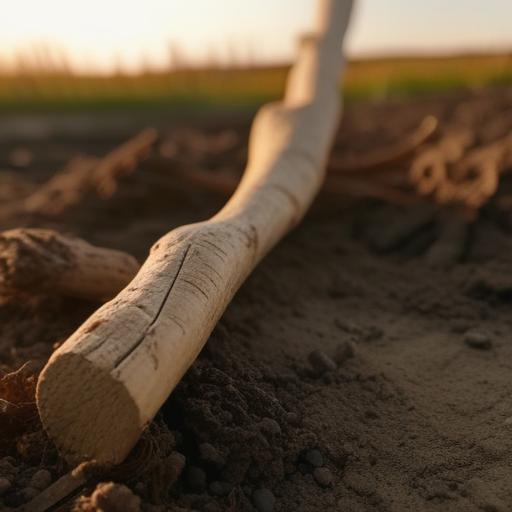
The Digging Stick was not just a sharpened branch. It was a precision-engineered lever.
- Leverage: By using a long, fire-hardened shaft and a specific “prying” motion, a harvester could exert hundreds of pounds of upward force, popping the deep tuber out of the ground without snapping the fragile taproot.
- The Tilling Ethic: As discussed in the Ethics of the Harvest, the act of digging was also an act of aerating the soil, creating a “nursery” for the next generation of seeds.
3. The Braided Warehouse: Preservation Technology
The Breadroot is available for a limited window in the early summer (the “Month of the Turnip”). Survival depended on the ability to preserve thousands of pounds of roots for the winter.

The Braid
The most iconic image of Plains foodways is the “Braid of Roots.” After harvesting, the thin, tough taproots were not cut off; they were used to braid the tubers together into long ropes, often 5 to 10 feet long.
- Convection Drying: These braids were hung from the exterior and interior poles of the lodge. The constant prairie wind and the smoke from the central fire performed a dual action: they removed moisture and provided a light “smoke-cure” that repelled insects.
- Portability: When it was time to move, the braids were simply rolled up and packed into rawhide parfleches. A single horse could carry enough “braided starch” to feed a family for a month.
4. Processing: From Rock-Hard to Creamy
A well-dried Prairie Turnip becomes as hard as a stone. This is a benefit for storage but a challenge for the cook.
The Grinding Circuit
Dried roots were processed using the Mortar and Pestle.
- The Flour: Pounded into a fine meal, the root became a versatile “flour” used to thicken soups or to create “travel cakes.”
- Wigmúŋke (The Root Pudding): The most prized way to consume tȟíŋpsila was as a thick, starchy pudding. The ground root was simmered with bison fat and dried berries, creating a dish with the consistency of oatmeal but a deep, earthy, nutty flavor profile.

The Thermal Threshold
Traditional cooks understood that starches require “gelatinization”—the process where starch granules absorb water and burst at high temperatures (approx. 160°F–180°F). By slow-simmering the roots in a ceramic pot or a hide-lined cooking pit with hot stones, they transformed the tough fibers into a highly digestible and comforting meal.
5. Biodiversity of the Starch Economy: Beyond the Turnip
While Psoralea was the staple, the “Starch Economy” utilized a diverse portfolio of species to ensure food security.
- Wild Onion (Allium spp.): Provided essential sulfur-compounds and acted as a digestive aid for the heavy protein of the bison. They were often dried and braided alongside the breadroot.
- Jerusalem Artichoke: Found in the river bottoms, these provided a “winter-accessible” starch. They survived freezing in the ground and could be dug up even in January.
- Groundnut (Apios americana): Growing as a vine in the wetter areas, its tubers have a remarkably high protein content (up to 17%) and were a favorite of the village-dwelling nations like the Omaha and Pawnee.
- Camas (Camassia): In the western foothills of the Rockies, the Camas bulb was the primary starch. Its preparation involved “pit-roasting” for 48-72 hours, a process that converted its complex inulin into sweet, highly-digestible fructose.
6. The Economics of the Trade: Roots for Corn
The starch economy was also the foundation of Plains Diplomacy. The nomadic nations who specialized in wild root harvesting (like the Lakota) frequently traded their braids of Tȟíŋpsila and their high-performance pemmican to the sedentary village nations (like the Mandan and Arikara) in exchange for corn, beans, and squash.
This trade ensured that both groups had access to a “diverse starch profile”—combining the stable, wild calories of the prairie with the high-yield, domesticated calories of the river valleys.
7. The Restoration of the Root
The destruction of the prairie for industrial agriculture led to the fragmentation of the wild root populations. Today, the “Starch Economy” is being rebuilt through Indigenous Land Stewardship.
- Re-Seeding: Community groups are actively re-seeding ancestral harvesting grounds.
- Nutritional Sovereignty: Returning Tȟíŋpsila to the diet is a primary goal of the “Decolonized Diet” movement. It offers a solution to the “white flour” health crisis by providing a nutrient-dense, low-glycemic alternative.
8. Conclusion: The Persistence of the Tȟíŋpsila
The root is a metaphor for the people. Just as the Breadroot hides its treasure underground, protected by the tough prairie sod, the traditional knowledge of the starch economy survived the attempts at its erasure.
Today, as we learn to use the digging stick and to braid the roots once again, we are not just reviving a recipe. We are reconnecting with the subterranean intelligence of the Plains—an economy built on resilience, patience, and the slow, deep energy of the earth.
Technical Summary: Starch Profiles of the Plains
| Root Species | Primary Carbohydrate | Harvest Window | Key Benefit |
|---|---|---|---|
| Breadroot (Tȟíŋpsila) | Complex Starch | June–July | High protein, shelf-stable, slow-energy |
| Jerusalem Artichoke | Inulin | Oct–March | Winter-hardy, prebiotic, low-glycemic |
| Wild Onion | Sugars/Sulfur | April–May | Digestive aid, Vitamin C |
| Groundnut | Starch + Protein | Sept–Oct | Highest protein density of any root |
| Camas (Western) | Inulin (Roasted) | Fall | Deep sweetness, high “social” value |
Recommended Tools for Root Harvesting
- Hand-Forged Steel Digging Tool: A modern, durable version of the fire-hardened ičápi.
- Hemp Twine: For braiding your roots if the taproots are too short.
- Vitamix or High-Power Blender: A modern “upgrade” to the mortar and pestle for creating fine root flour.
View Professional Root Digging and Processing Tools on Amazon
Next in our Foodways Series: The Sweet and the Bitter - Berries and Tonics.