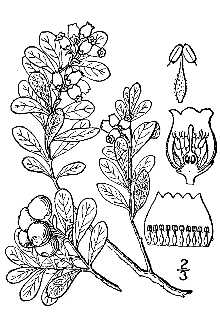
kinnikinnick
Uva-Ursi uva-ursi (L.) Britton, nom. inval.
Medicinal Documentation
Infusion of stems, leaves, and berries taken for back pain and sprained backs. Poultice of wetted leaves rubbed on the back for pain Additional commentary: These leaves, dried, are mixed with the inner bark of Cornus stolonifera, (red-osier dogwood, red willow) or tobacco as a smoking blend. The leaves were also involved in a mixture burnt to drive away the bad spirits that were making a person go mad. For persistent pain in the back, especially from a sprain, the leaves, stems and berries were boiled in a tea, and the leaves alone would be wetted and applied to the sore spot.105 The berries would be mixed with those of Amelanchier alnifolia and Prunus virginiana among others as a medicine.106 Grinnell mentions that kinnikinnick is used as a diuretic when one’s kidneys are congested; this may be related to its use for back pain.107 According to William Tallbull, the plant is often picked during the winter, usually under the snow. According to protocol, an offering is left nearby.108
Leaves wetted and used for pain relief
Berries and other plants used for colds and coughs
Berries used as an ingredient in medicinal mixtures.
Leaves burned to drive away bad spirits for people going crazy.
Ceremonial & Cultural Notes
Artifacts: The berries produce a gray-brown dye | Artifacts: Use the leaves as an ingredient in their smoking tobacco mixture.
Artifacts/Material use: Leaves mixed with skunkbush leaves in the absence of tobacco and smoked.
Artifacts/Material use: Leaves mixed with tobacco or red willow and used to smoke in a pipe.
Botanical Reference
Parts Documented: Berries, Not specified in the literature, leaves, stems
Distribution: Well-drained, open or wooded sites; foothills to alpine; Alaska to New Mexico; Alaska to New Mexico. In the western United States typically associated with ponderosa pine forests.