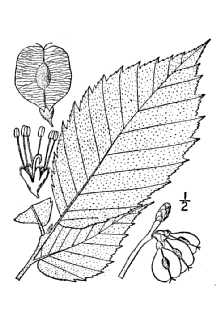
slippery elm
Ulmus fulva Michx.
Traditional Food Use
The young leaves are edible when they are cooked and are very high in vitamins and minerals.
The fresh inner bark used to brew a "tea."
Medicinal Documentation
They also make a nice tea that can be used to treat stomach aches. An infusion is also used to treat arthritis, rheumatism, and eczema. The whole plant is used to make a salve that is excellent in treating sciatica, eczema, and dandruff. The young leaves are made into a decoction that is taken internally to treat hives.
Fresh, inner bark used as a masticatory.
Botanical Reference
Parts Documented: leaf, stem, whole plant
Safety Notes: Tiny hairs cover the entire plant and, when touched, release a trio of chemicals that causes a burning rash, similar to poison ivy but much shorter in duration and very easy to relieve.