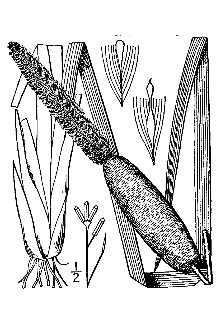
broadleaf cattail
Typha latifolia L.
Traditional Food Use
Young shoots are collected and eaten like celery
Medicinal Documentation
An infusion of the outer and inner bark is used to treat TB and lung hemorrhaging, coughs, colds, influenza, dysentery, eye infections, cramps and diarrhea.
Pulverized root and leaves are steeped in hot water and given as a drink to relieve cramps in the abdomen – “belly-ache”
Ceremonial & Cultural Notes
Artifacts/Material use: Cattail leaves were woven into mats for the lodge floor
Artifacts/Material use: Cattail fluff was placed in baby cradles as diaper material
According to Ben Black Wolf, Jim Spear, and Wesley White Man, cattail leaves played a role in the Sun Dance, but perhaps more technologically, as they were used similarly to wild rye, that is, as a cooling bedding upon which the dancers could stand.
Botanical Reference
Parts Documented: bark, cattail_fluff, leaves, roots, white_base_of_leaves, young_shoots
Distribution: Still, slow moving waterways; plains to montane; Northwest Territory, Canada to New Mexico