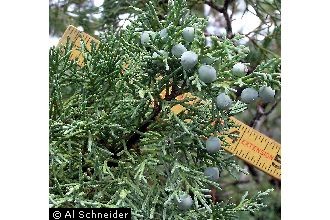
Rocky Mountain juniper; 199
Sabina scopulorum (Sarg.) Rydb.
Traditional Food Use
Young shoots and leaves used to make a tea | Ute: Eaten raw or cooked
Medicinal Documentation
Infusion of boughs, branches and cones chewed used for colds or a steam bath.
Infusion of leaves, boughs or fleshy cones taken for constant coughing
Infusion of boughs, branches and fleshy cones used for fevers.
Leaves burned at childbirth to promote delivery
Infusion of boughs, branches and cones used for pneumonia, colds, fevers, and tonsillitis
Infusion used for sedating hyperactive persons.
Infusion of leaves taken for a tickling in the throat Additional commentary: “A tea made by steeping the leaves and drunk will relieve constant coughing or tickling in the throat”
Ceremonial & Cultural Notes
Berries from different trees were sampled to discover which tree held the sweetest fruit as they varied in taste. Women rubbed the fruit on a metate with a mano to separate the seeds from the pulp. The pulp was either eaten fresh or cooked. The juniper berry pulp also would be dried and later ground on a metate.89
Leaves burned as incense in ceremonies, especially to remove fear of thunder and lightening Additional commentary: This species of juniper has many uses as relayed by Northern Cheyenne community members. The leaves are burnt as purifying incense in many ceremonies including the Sun Dance, in which the instructors, pledger, crier, buffalo skull and robe are all bathed in Juniper’s purifying smoke. This juniper is, or was, also believed to have a special relationship, or power, with Thunder, that prevented it from ever being struck. Consequently this juniper was petitioned in ceremony to alleviate a person’s fear of thunder; a ceremony that took place around a lone juniper and burned juniper leaves as incense. Juniper leaves were also burnt at childbirth to help promote delivery. For colds, including a cough or throat discomfort, fever and tonsillitis, a tea is made from the boughs or the fleshy cones and the steam from this hot infusion is used as a vaporizer. Furthermore, the fleshy cones can also be chewed for relief from such ailments. If the longing one might feel for a lover can be considered an ailment, then I must also include the use of flutes made of juniper wood as love medicine. The use of juniper wood in this case may be more about the wood’s functionality as a material than about abstract powers it may have, for these flutes are made only by special men who have the peculiar ability to charm a girl and make her return the love a man feels for her. An argument for the juniper wood containing love medicine is that another kind of flute is made of this wood, not by men with special powers, but is nonetheless instrumental in the courting process. Juniper, an evergreen, also represents youthfulness because it does not fall victim to the autumn’s withering—its leaves remain young and vibrant while other trees’ leaves grow old and die. Accordingly, the plant is placed centrally in many holy Cheyenne rituals and ceremonies. Rocky Mountain juniper and Creeping juniper often hybridize when their eco- zones overlap. However, the Rocky Mountain juniper is more common in the southern Rockies, while the Creeping juniper dominates further north.380
Artifacts/Material use: Knots used to make bowls
Wood flutes used to "charm a girl whom a man loved to make her love him."
Artifacts/Material use: The wood used to make bows Additional commentary: The Cheyenne found the wood desirable to make bows, lance shafts, and other items because of its dark red dyed in blood color inherent in the wood.391
Burned as incense or offering when making medicine
Artifacts/Material use: Wood used to make courting flutes.
Spiritual/Religious: Needles used to cedar or smudge for spiritual preparation Commentary: The same terms and uses are applied to Juniperus communis and other Sabino species.211
Botanical Reference
Parts Documented: Young shoots and leaves, Berries, boughs, boughs_or_fleshy_cones, branches, cones, fleshy_cones, infusion_of_leaves_taken_for_a_tickling_in_the_throat, knots, leaves, wood, wood_branches, Needles
Distribution: Dry, rocky open sites, foothills to montane. Found from Alberta, Canada south into New Mexico; Dry, rocky open sites, foothills to montane. Found from Alberta, Canada south into New Mexico.