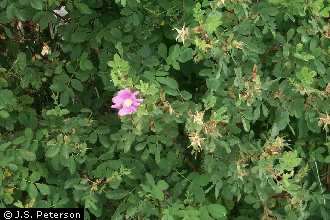
Woods' rose
Rosa woodsii Lindl.
Traditional Food Use
The fruits are eaten raw or dried for later.
Both barks are used to make tea. | Bark used to make tea.
Berries not to be eaten too freely Additional commentary: The Cheyenne name for the rose hip of Rosa woodsii is Hih’ nin or “to pour out” referring to pouring of water. The term also is applied to tomato.625
Medicinal Documentation
An infusion of the leaves is used to treat diarrhea in children. An infusion of the roots is used to treat sore eyes. A decoction of the leaves is used to treat infected
Seeds used to produce a drawing effect for muscular pains.
The inner bark or roots are boiled into a tea to treat diarrhea and stomach trouble Additional commentary: The Cheyenne name for the rose hip of Rosa woodsii is Hih’ nin or “to pour out” referring to pouring of water. The term also is applied to tomato.627
The petals, inner bark or roots are boiled into a tea, which is used as an eyewash to treat snowblindeness Additional commentary: The Cheyenne name for the rose hip of Rosa woodsii is Hih’ nin or “to pour out” referring to pouring of water. The term also is applied to tomato.629
Ceremonial & Cultural Notes
Artifacts: Root used to make an orange dye
Botanical Reference
Parts Documented: root, leaf, fruit_or_berry, Bark, Seeds, berries, inner_bark_or_roots, petals
Distribution: Native to North American Plains; widespread regional distribution; Prairies, ravine, and stream banks; Grows in a wide range of habitats; plains to sub-alpine zones; Northwest Territory, Canada to Colorado and Utah