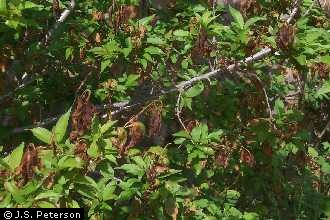
American plum
Prunus americana Marshall
Traditional Food Use
The fruits are eaten raw or dried for later use.
Fruits eaten dried and stored for later use
Eaten raw | Ute: Sun dried for winter use
Fruits, sugar and flour used to make a pudding. Fruits pulverized, sun dried, boiled and eaten as a delicacy. Also, sun dried plums stored for winter use
Fruit gathered in great quantities and used immediately. Fruit gathered in great quantities, dried and stored for winter use.
Medicinal Documentation
Fruits were crushed, mixed with salt that was obtained from Oklahoma, and used as part of a medicinal mixture to treat a kind of mouth disease Additional commentary: Mary Fisher and Charles Sitting Man reported that the fruits were crushed, mixed with salt that was obtained from Oklahoma, and used as part of a medicinal mixture to treat a kind of mouth disease.564 In addition, Moerman indicates a ceremonial use.565
Botanical Reference
Parts Documented: fruit_or_berry, fruit, fruits
Distribution: Native to North American Plains; widespread regional distribution; Dry to moist; open sites; plains to montane; southern Northwest Territory, Canada to New Mexico