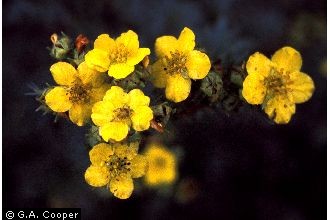
shrubby cinquefoil
Potentilla fruticosa L.
Traditional Food Use
A pleasant tea is made from the leaves INTRODUCED: The root is edible in the same manner as cultivated carrots.
Drank as a beverage tea
Medicinal Documentation
An infusion of the Queen Anne's Lace, leaves is taken to prevent and even eliminate kidney stones.
Ceremonial & Cultural Notes
During the Contrary Dance the plant is used to protect the hands from injury when they are thrust into the kettle of boiling soup. Dried leaves are ground into a fine powder and may rubbed over the hands and body after soaking in cold water. It is then rubbed on the body for protection. Additional commentary: Like red globemallow, shrubby cinquefoil was used to protect the hands when thrust into a kettle of boiling water. It was either rubbed directly on the body, as a powder made from the finely ground dried leaves, or rubbed on the body as a coldwater infusion. It was said to protect the body from severe, but temporary heat.558
It was regarded as a medicine against the enemy
Artifacts/Material use: It was manufactured into a arrow poison Additional commentary: Only holy people could use and prepare the deadly arrow poison derived from this plant. The poison brewed from the leaves was thought to go directly to the heart. In addition to dipping arrows into the poison, it was also put into porcupine quills and shot into the mouth. Before the encounter with Custer’s troops the Keeper of the Sacred Hat wanted to use poison arrows in the battle, but the plant could not be found along the Little Big Horn River.
Dried, powdered leaves rubbed over hands, arms and body for Contrary dance. Additional commentary: Referred to as Pentaphylloides floribunda and Potentilla fruticosa. Grinnell describes the use of this plant as similar to other contrary medicine. The leaves are dried, after which time they are ground into a powder. The powder can be rubbed over the hands and body, or an infusion of the powder in cold water can be rubbed over the body—either method is used to protect the contrary society member from the scalding hot water into which he thrusts his hands to fetch boiling meat as part of the ceremony.240
Plant used as a medicine against an enemy.
Artifacts/Material use: Plant considered poisonous
Botanical Reference
Parts Documented: root, leaf, leaves, plant
Safety Notes: One must be very careful not to confuse this plant with poisonous hemlock (Conium maculata or Cucuta maculata).
Distribution: Meadows and rocky slopes. Found is damp to wet saline soils for the Great Plains to about 9,000 feet in elevation.; Wet to dry, often rocky sites; plains to sub-alpine; Alaska to New Mexico