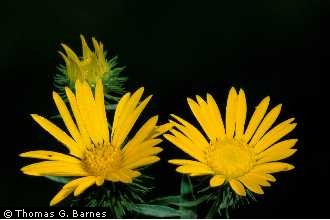
curlycup gumweed
Grindelia squarrosa (Pursh) Dunal
Medicinal Documentation
a day, will relieve constricted airways and even help to dry phlegm The root is chewed for its pleasant flavor and to treat toothache and the flu. A decoction of the dried root or leaves is used to treat diarrhea, upset stomach, fever, coughs, chest pain, and sore throat. Leaves are steeped to produce a topical treatment for earache. The American licorice, leaves are chewed and applied as a poultice to the sore backs of horses.
Decoction of flowering tops applied to skin diseases, scabs and sores
Gum rubbed on the outside of eyes for snow blindness. Additional commentary: Elders indicate that the flowering tops of gumweed were boiled and applied externally in cases of skin diseases, sores, or scabs. It could also be used as a remedy for snow blindness. In this case, the gummy residue would be rubbed on the eyelids.322
Decoction of flowering tops used to wash sores and other skin lesions.
It was used to treat kidney and bladder problems
A tea was used for expulsion or loosening of mucous for coughs, whooping cough, pneumonia, bronchitis, asthma, and colds.
Used as a cough medicine.
Ceremonial & Cultural Notes
Commentary: Murphey names the plant Ithi wa hyine, possibly meaning “Dog flower head.”101
Botanical Reference
Parts Documented: root, leaf, Not specified in the literature, flowering_tops, gum
Distribution: Pastures and disturbed areas; dry, open sites; plains to foothills; Alberta, Canada to New Mexico