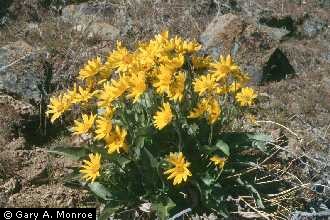
arrowleaf balsamroot
Balsamorhiza sagittata (Pursh) Nutt.
Traditional Food Use
Roots roasted or steamed for food; young shoots and leaves eaten cooked; seeds roasted. | Blackfeet: Roots roasted or steamed for food; young shoots and leaves eaten cooked; seeds roasted. | Blackfeet: Roots roasted or steamed; important spring food.
Root is eaten raw or baked. The root is large and can make a substantial meal
Young shoots and leaves eaten | Ute: Roots were eaten to some extent
Medicinal Documentation
Root poultice used for wounds, burns, and sores; decoction taken for coughs and respiratory illness. | Blackfeet: Root poultice used for wounds, burns, and sores; decoction taken for coughs and respiratory illness. | Blackfeet: Poultice for burns and wounds.
Steam of plant decoction inhaled for headache and used as wash on head.
Infusion of leaves, stems, and roots taken for colds.
Infusion of root taken for fever
Decoction of root taken when labor begins, to insure easy delivery
Root chewed and saliva allowed to run down the throat for sore mouth and throat
Root chewed and rubbed over the body for any sickness
Root chewed for toothaches
Infusion of leaves, roots, and stems taken for stomach pains and headaches Additional commentary: For pains in the stomach and for colds, a tea was made of the leaves, roots, and stems. For headaches, a person would hold her head over the steam of this infusion. In childbirth, a woman was given the root to facilitate the process. Moerman states that B. sagittata is used as a gynecological aid, an oral aid, a panacea, a throat aid, and a toothache remedy, and that both species of Balsamhorriza are used as an analgesic, a cold remedy, and in gastrointestinal issues.161
Ceremonial & Cultural Notes
Used ceremonially by Blackfeet; burned as incense in some ritual contexts. | Blackfeet: Used ceremonially by Blackfeet; burned as incense in some ritual contexts. | Blackfeet: Burned as incense; known as 'holy turnip'.
Botanical Reference
Parts Documented: root, leaf, seed, leaves, plant, roots, stems, Young shoots and leaves
Distribution: Native to western Plains and foothills; widespread in prairie margins; Dry, often stony, open or wooded sites; foothills to montane; Alberta, Canada to Colorado