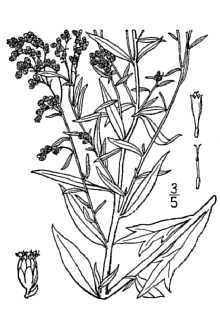
white sagebrush
Artemisia ludoviciana Nutt.
Medicinal Documentation
A decoction of the leaves is used to treat indigestion and sore throat. An infusion of the dried leaves is used to treat pneumonia, colds, coughs and bronchitis. It is used both internally and externally to treat rheumatism. A poultice of the crushed plant is used on open wounds, and a decoction of the leaves is used as an antiseptic wash for cuts, wounds | Cheyenne: Tea used for stomach issues and fevers. | Arapaho: Tea used for stomach issues and fevers. | Kiowa: Used for stomach ailments and fevers.
Crushed leaves used as snuff for headaches. Additional commentary: The leaves of this sage were crushed and used as a snuff for sinus attacks, nosebleeds, and headaches. More importantly, is this sage’s role in ceremonies and as a general purifying plant. In almost every ceremonial lodge, it was spread along the floor and the leaves burned as incense. In this capacity it would drive away bad spirits, and dark dreams; it would sometimes be mixed with Actaea rubra to accomplish this task. In purification, its smoke would be spread over people, utensils, or through a space. Contrary warriors relied on it to purify people or horses that had been accidentally touched by their special lances, or to cleanse the soil when they left a lodge. If a person had broken a taboo, s/he might be wiped clean of it with a bundle of this sage. Beds of sage were stood and rested upon in the Sun Dance, from which the dancers would draw power. It was used to prevent thirst in the Sun Dance by wrapping it around the eagle bone whistles, and offerings of food were made to the spirits in this ceremony from bits of sage that had been dipped in the food. It was used to paint the dancers and again to wipe the paint off. In battles, shields would be passed ritualistically through its smoke. In the aforementioned ceremony to allay the fear of thunder, a half circle of sage would be spread around the thunder-resistant juniper tree and upon which the person walked during the ceremony, drawing forth a sacred blessing. According to Northern Cheyenne elders, a person in a sweat lodge would dip a leafy stem in water, sprinkle some water on the hot rocks, and the branch would be whipped upon the participants’ bodies. In a peyote ceremony, petitioners rub sage on their bodies to keep them from getting sick. These days, according to Mary Fisher of the Northern Cheyenne, hunters wipe their rifles with sage for much the same reasons. Grinnell indicates its ceremonial use, referring to man sage as A.gnaphalodes, and Moerman additionally indicates its use as a respiratory aid.120
Crushed leaves used as snuff for nosebleeds
Crushed leaves used as snuff for sinus attacks
Plants rubbed on the body for immunity to sickness
Plant used to drive away bad or ominous dreams.
Poultice of chewed leaves and applied to sores.
Leaves chewed for sore throats. Leaves chewed for sore throats.
Ceremonial & Cultural Notes
Smudging and purification. | Arapaho: Smudging and purification. | Kiowa: Purification and spiritual cleansing.
Plant used in various ceremonies
Plant used extensively in ceremonies to drive away bad spirits, evil influences, and ominous dreams.
Leaves burned as incense in ceremonies to purify implements, utensils or persons.
Plants wiped on persons who broke taboos for purification.
Plants wrapped around Sun Dancers' eagle bone whistles for prevention of thirst.
Sprigs used as ceremonial paint brushes during the Sun Dance ceremony
Sprigs used in sweat lodges to sprinkle water on the rocks
Plant used for many ceremonial purposes
Plant used in ceremonies
Plant used as a purifying agent in the sweathouse.
Commonly employed in peyote meetings
Botanical Reference
Parts Documented: leaf, stem, crushed, leaves, plant, plants, sprigs
Distribution: Native to North American Plains; widespread regional distribution; Native to Great Plains; documented Cheyenne use; Dry, open sites; plains, prairies to montane, and disturbed areas; Alberta to New Mexico; plains to montane; British Columbia and Alberta, Canada to New Mexico. Also found in semi-disturbed sites.