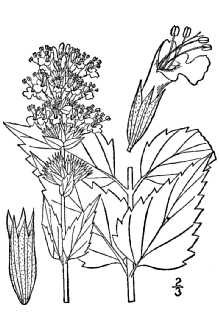
blue giant hyssop
Agastache anethiodora (Nutt.) Britton
Traditional Food Use
Leaves used to make tea
Medicinal Documentation
the heart Root is edible - it is harvested in the late fall and then dried for later use.
Infusion of leaves used for chest pains from coughing. Infusion of leaves also taken as a cold medicine Additional commentary: A tea made of the leaves was drunk for cardiac weakness and pains in the chest or lungs, say, from coughing, or for treating colds. This tea is also drunk for “dispirited heart.” When prepared differently it was used to break a fever. The powdered leaves were rubbed on the body to cool it, and a vapor bath of the leaves was used to induce sweating.54 A special medicinal mixture consisting of this plant and nine others is also mentioned.55 Grinnell mentions this use for Agastache anethiodore.56
Leaves used in a sweat lodge and steam bath to induce sweating
Powdered leaves rubbed on the body for high fevers.
Infusion of leaves taken to correct dispirited heart.
Cold infusion of leaves taken for chest pains caused by coughing.
Cold infusion of leaves taken for chest pain.
Infusion of leaves taken for its medicinal qualities.
Cold infusion of leaves taken for weak heart.
Botanical Reference
Parts Documented: root, leaves
Safety Notes: Use caution when harvesting in the fall, as one must ensure correct Alisma plantago- identification so as to not confuse the tubers of this plant with
Distribution: Moist, open sites; prairies, foothills, upland woods to sub- alpine; southern British Columbia, Montana to Colorado; prairies, foothills, upland woods