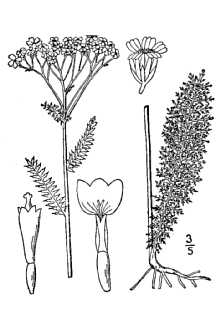
common yarrow
Achillea millefolium L.
Traditional Food Use
The seeds are edible when cooked. They are often ground into flour and Achnatherum used to make bread or to thicken soups.
Medicinal Documentation
Infusion of leaves and flowers taken for chest pains. Additional commentary: As indicated by Northern Cheyenne elders, yarrow is enlisted to aid in coughs, colds, sore throats and even slight nausea. Similarly, it was used to deal with tuberculosis or other chronic respiratory illnesses. For these uses, the plant, fresh or dried, would be finely ground into a powder that was boiled to make a tea. The tea can also be drunk for heart and chest troubles. Yarrow, a diaphoretic, also induces sweating, and would be employed after a sweat bath. Yarrow would also be chewed and rubbed on the body to soothe it. Crushed leaves can be used externally to stop bleeding, as well, and would be chewed and put in a person’s nostrils to stop a nosebleed.18 Grinnell indicates yarrow’s use as a cough medicine and throat aid under the name A. lanulosa.19 Moerman adds to this its use as a febrifuge and hemostat.20
Infusion of fresh or dried plant taken for nausea.
Infusion of fresh or dried leaves used for colds and coughs.
Infusion of fresh or dried plant taken to cause perspiring.
Infusion of leaves used for fevers.
Infusion of leaves and flowers taken for heart troubles and chest pains.
Crushed leaves placed in the nose for nosebleeds
Infusion of plant taken or leaves rubbed on body for respiratory diseases.
Infusion of fresh or dried plant taken for tickling of the throat.
Infusion of plant taken or leaves rubbed on body for tuberculosis.
Poultice of plant applied externally to bruises. | Ute: Administered as a panacea. An infusion of the plant taken for cases of sickness
Botanical Reference
Parts Documented: seed, flowers, leaves, plant, plant_or_leaves
Distribution: Native to North American Plains; widespread regional distribution; Prairies, meadows, open woods, especially areas of mild disturbance. The plant thrives in dry to moderately moist soil, from valley floors to above the timberline