Fiber: The Cordage of the Plains
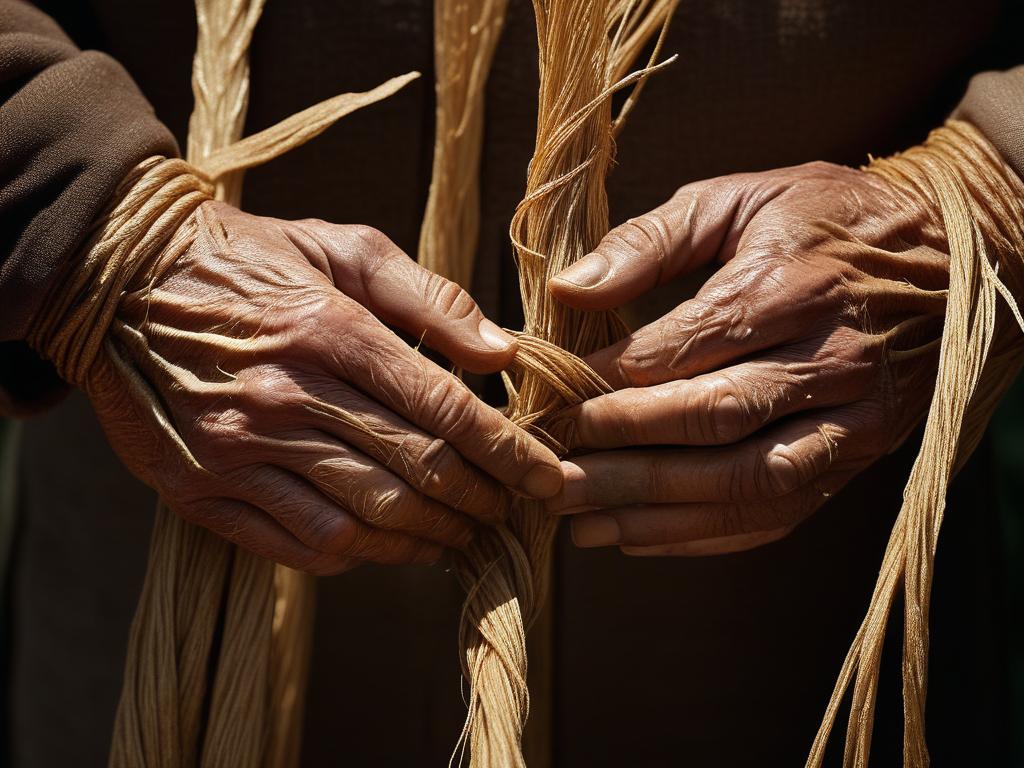
The Invisible Infrastructure
On the Great Plains, where the buffalo was king and the wind was constant, an invisible technology held the world together. While the history books often emphasize the stone blade and the bow, it was the cord that made the weapon possible. Without cordage, there were no fishing nets to harvest the rivers, no snares to catch the prairie chicken, no lashings for the lodge poles, and no intricate beadwork to tell the stories of the people.
Ethnobotanical fiber is the material science of the Plains. It is the art of identifying specific plant tissues—primarily the “bast” fibers located between the outer bark and the inner wood—and transforming them into high-tensile lines that can withstand hundreds of pounds of pressure. In this 2,000-word deep dive, we explore the botany, the engineering, and the cultural legacy of the Great Plains fiber plants.
1. The Botany of Tensile Strength
To understand cordage, one must understand the microscopic architecture of a plant. Most high-quality fibers used by the Great Plains nations were bast fibers. These are specialized cells within the phloem of certain dicotyledonous plants. Their biological function is to provide structural support to the plant’s stem, allowing it to remain upright against the fierce prairie winds while remaining flexible enough not to snap.
The Cellulose Matrix
The strength of these fibers comes from cellulose, a complex carbohydrate that forms long, linear chains. These chains are bundled together into microfibrils, which are further organized into macrofibrils. In plants like Indian Hemp or Nettle, these cellulose fibers are incredibly long and lack the brittle “lignin” found in wood. This combination of length and purity is what gives traditional cordage its famous strength-to-weight ratio, which in many cases rivals modern high-performance synthetics like nylon.
2. Indian Hemp (Apocynum cannabinum): The Gold Standard
Among the Plains nations—including the Lakota, Cheyenne, Arapaho, and Pawnee—one plant stood above all others for cordage: Apocynum cannabinum, commonly known as Indian Hemp or Dogbane.
Identification and Harvesting
Indian Hemp is a perennial herb that thrives in riparian zones, low-lying meadows, and areas with high water tables. It can be identified by its reddish stems, milky sap (which contains toxic cardiac glycosides, necessitating care during processing), and opposite, lance-shaped leaves.
The timing of the harvest was critical. While the plant could be harvested in late summer, the most potent fiber was obtained in the late fall or early winter, after the first hard frosts had killed the plant and the stems had begun to “cure” on the stalk. At this stage, the outer bark begins to separate naturally from the bast fibers, a process practitioners call “field retting.”
Processing: From Stalk to Ribbon
The transformation of a woody stalk into a silky ribbon of fiber is a multi-stage process of mechanical separation:
- Cracking: The dried stalks are flattened or cracked, often using a smooth stone or the heel of the hand, to break the woody inner core (the “hurd”).
- Peeling: The outer bark and the attached bast fibers are peeled away from the hurd in long, continuous strips.
- Cleaning: The “scutching” process involves scraping the bark away from the fibers. Traditionally, this was done by pulling the fiber strips over a blunt bone tool or even through the teeth, though the latter was risky due to the plant’s toxicity.
- Buffing: Finally, the fibers were rubbed vigorously between the palms to remove any remaining vegetable matter, leaving behind a bundle of fine, silver-gold filaments.
The Engineering of the Twist
The strength of a single Indian Hemp fiber is negligible; the power lies in the twist. Plains practitioners used a “thigh-rolling” technique. By placing two bundles of fiber on the thigh and rolling them downward with the palm, the fibers are twisted into “singles.” When the palm is lifted and rolled back upward, the two singles naturally wrap around each other in the opposite direction (a process known as plying). This creates a “Z-twist” or “S-twist” cable that is mechanically locked. As tension is applied to the cord, the fibers compress against each other, increasing the friction and preventing the line from slipping.
3. Stinging Nettle (Urtica dioica): The Hidden Giant
While Indian Hemp was the gold standard for heavy-duty cordage, Stinging Nettle was the master of fine-gauge line. Known to the Lakota as Čhaŋíčaȟpe, the nettle provided a fiber that was thinner, softer, and arguably stronger than hemp.
The Science of Nettle Fiber
Nettle fibers are remarkably fine—often only a few microns in diameter—yet they possess a tensile strength comparable to flax. Unlike hemp, which has a slightly oily texture, nettle fiber is dry and takes dyes exceptionally well.
Processing Nettle
Because of the “stinging” hairs (trichomes) containing formic acid and histamine, the initial harvest was a task of both caution and skill. Once dried, the sting is neutralized. The processing of nettle often involved water retting. The stalks would be submerged in a slow-moving stream or a pond for several days. This allowed bacteria to eat away the pectins holding the fibers to the stalk, leaving behind only the pure cellulose.
Applications
Nettle cordage was the primary material for fishing nets and bird snares. Its neutral color and lack of scent made it nearly invisible in the water or the underbrush. In the northern plains, where nettle grew in massive, 6-foot-tall stands, it was also used to weave soft mats and even lightweight summer clothing.
4. Milkweed (Asclepias spp.): The Versatile Utility
Every part of the Milkweed was utilized, but its stalks provided a reliable “utility grade” fiber for daily tasks. While not as strong as Indian Hemp, Milkweed fiber was abundant and required less processing.
The “Fluff” as Insulation
Beyond the cordage in the stems, the seed pods of the Milkweed (Asclepias syriaca) provided a unique material: the “fluff” or coma. This material is made of hollow, wax-coated tubes that are incredibly buoyent and highly insulating. While it cannot be easily spun into cordage due to its lack of surface scales, it was stuffed into moccasins and children’s clothing as a thermal barrier during the brutal Plains winters.
5. The Engineering of the Cable: Tensile Physics
The Great Plains engineers understood that different tasks required different rope architectures:
- Single-Ply (The Thread): Used for fine beadwork and sewing hide. Often made of single, long fibers of Sinew or Nettle.
- Two-Ply (The String): The standard for fishing lines and small traps. The counter-twist ensures the line doesn’t unspool when wet.
- Three-Ply and Braided (The Rope): For tethering horses or securing lodge poles. By braiding multiple three-ply lines together, a cable could be created capable of securing a half-ton of bison meat on a travois.
Directionality and Torsion
Traditional cordage is almost always “counter-plied.” If the individual strands are twisted to the right, they are plied to the left. This creates a state of internal tension that keeps the rope from kinking. On the Great Plains, where ropes were subjected to extreme moisture (rain/snow) and then rapid drying in the sun, this torsional balance was the difference between a tool that lasted a season and one that lasted a decade.
6. Traditional Applications: Weaving the World
The Bowstring
Perhaps the most critical application of fiber was the bowstring. While sinew (animal tendon) was common, it was highly susceptible to moisture—it would stretch and go limp in the rain. High-quality Indian Hemp bowstrings, often treated with a coating of pine resin or beeswax, maintained their tension in all weather conditions, a vital advantage during a damp hunt or battle.
Equestrian Gear
The arrival of the horse transformed Plains culture, but the horse required cordage. Halters, leads, and cinches were woven from heavy-gauge plant fibers. These botanical cinches were often preferred over leather because they were more breathable and less likely to cause “gall” or sores on the horse’s underside.
The Fish Weir and Net
Along the Missouri River and its tributaries, the Mandan and Hidatsa engineered massive fish weirs and nets made entirely of Nettle fiber. These nets had to withstand the force of the current and the thrashing of large Missouri sturgeon. The ability to create hundreds of feet of uniform, high-strength line was a community-wide effort that underpinned the village economies.
7. The Cultural Ethic: The Patience of the Twist
To make 50 feet of high-quality two-ply cordage requires hours of harvesting, days of processing, and thousands of repetitive hand motions. In Plains Native cultures, this was not seen as “labor”—it was a meditative, community-building activity.
As the hands moved, stories were told. The “twist” of the cord was seen as a metaphor for the binding of the people to the land. There is a deep ethic of patience and foresight in cordage making. You harvest in the fall for the cord you will need in the spring. You process today for the net you will use tomorrow. This long-term thinking is the heart of indigenous sustainability.
8. Modern Ethnobotany: Preserving the Skill
Today, the skills of traditional cordage are being revitalized. Scholars and indigenous practitioners are returning to the creek beds to harvest the Apocynum. By teaching the “thigh-roll” to the next generation, they are not just making string; they are reconnecting a severed line of cultural transmission.
For the modern seeker, the lesson of the fiber plant is one of relationship. When you spend three hours processing a single nettle stalk, you can no longer view that plant as a “weed.” It becomes a teacher of physics, a source of strength, and a bridge to the ancestors who walked these same grasslands.
Recommended Tools for the Modern Cordmaker
For those looking to practice these skills today, several modern tools can assist in the transition from raw plant to finished line:
- High-Quality Pruning Shears: For clean, non-crushing harvests of Indian Hemp stalks.
- Smooth Sanding Blocks: For buffing fibers without tearing the delicate cellulose.
- Traditional Bone Folders: Excellent for the initial “splitting” of the woody hurd.
View Cordmaking and Fiber Processing Tools on Amazon
Technical Summary Table
| Plant Species | Primary Tissue | Strength Rating | Best Use Case |
|---|---|---|---|
| Indian Hemp | Bast (Phloem) | Very High | Bowstrings, horse gear, heavy lashings |
| Stinging Nettle | Bast (Phloem) | High | Fishing nets, fine thread, summer clothing |
| Milkweed | Bast & Pith | Medium | General utility, winter insulation (fluff) |
| Yucca | Leaf Fiber | High | Sandals, baskets, heavy-duty cordage |
Next in our Materials Series: Dyes of the Prairie: The Chemistry of Natural Pigment.